
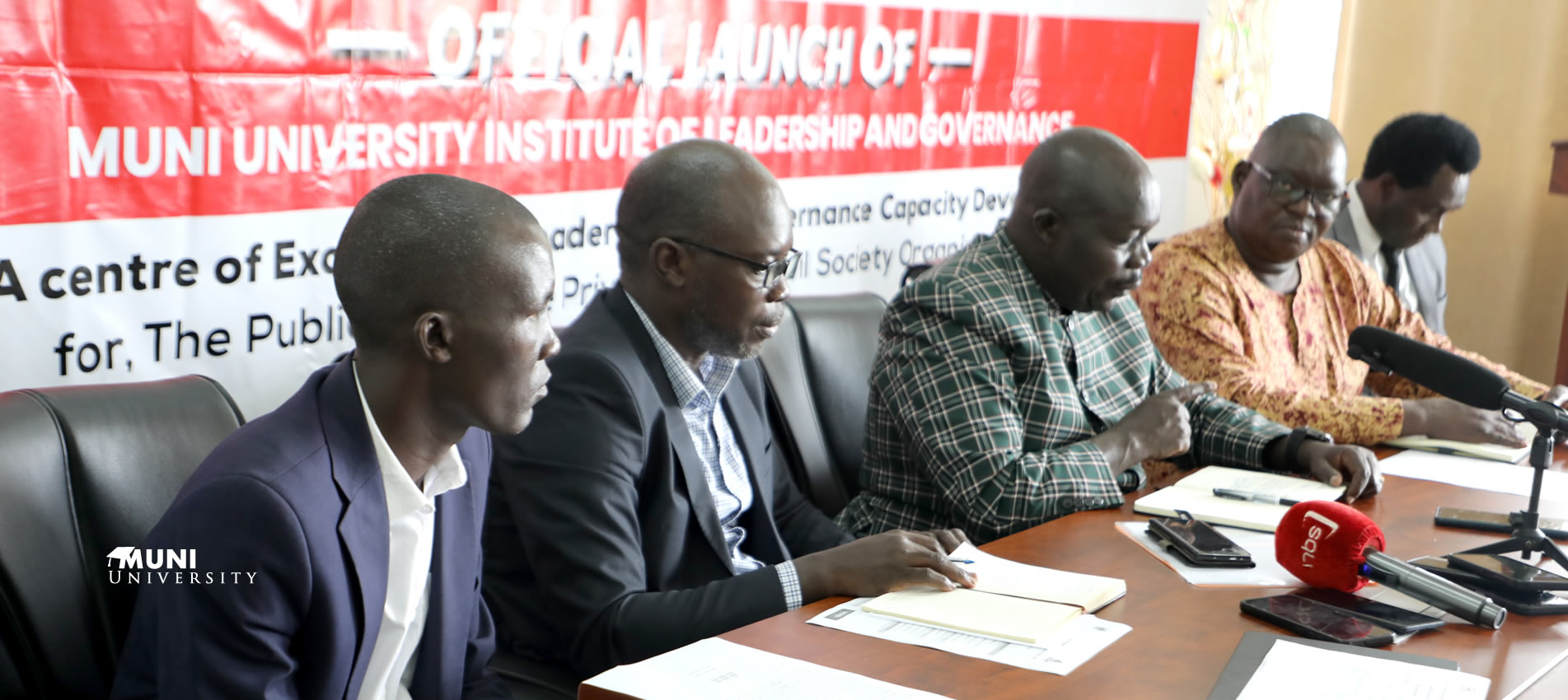
Muni University has convened a high-level press conference to set the stage for the official launch of its Institute of Leadership and Governance on 23rd March 2026.
The press conference, held on 18th March 2026 at the University Main Campus in Arua City Centre, highlighted the institution’s bold and forward-looking vision of transforming leadership and governance in Uganda and the wider region.
With a strong reputation for academic excellence, innovation, and community engagement, Muni University is positioning the Institute of Leadership and Governance as a flagship centre for nurturing competent, ethical, and impactful leaders.
Addressing the media, Associate Professor Simon Anguma Katrini, the Vice Chancellor, said leadership remains the backbone of any successful society.
“If leadership is wrong, everything goes wrong. This institute is our deliberate intervention to equip leaders with practical skills, values, and knowledge to transform communities,” he said.
He noted that the institute will serve as the university’s primary vehicle for community outreach through leadership training, coaching, and research. Although it will not independently award degrees, it will complement academic programmes across faculties and strengthen the university’s impact on society.
The Vice Chancellor revealed that the institute has already rolled out leadership capacity-building programmes in Arua City, Terego, Yumbe, and Koboko, as well as Bulambuli District in Eastern Uganda.
“This is a practical institute. We have already started working with communities because leadership development cannot wait,” he added.
The institute is built on extensive community needs assessments and will target leaders in the public sector, private sector, civil society, religious institutions, cultural institutions, and refugee-led organizations.
Moses Otim, Director of the West Nile Development Association, welcomed the initiative and emphasized the importance of aligning leadership development with national priorities.
“We are committed to supporting initiatives that strengthen leadership and governance in our region and the country at large,” he said.
Feni Twalib, Chief Administrative Officer of the West Nile Regional Civil Society Network, called for a collective approach in addressing governance challenges.
“Building competent leadership requires joint effort. This institute provides the platform we need to shape responsible and accountable leaders,” he noted.
Dr Felix Andama Adiburu, Chairperson of the Organising Committee, said the institute is grounded in research and community engagement.
“We have conducted needs assessments and clearly understand the leadership challenges in our communities. We are ready to empower leaders and also address emerging issues such as migration and refugee integration,” he said.
Muni University continues to distinguish itself through initiatives that blend teaching, research, and community transformation. The university has invested in e-learning technologies, strengthened research systems, and expanded mentorship programmes in schools to improve academic performance.
Professor Jacob Agea, the Deputy Vice Chancellor in charge of Academic Affairs, emphasized the university’s commitment to quality education and continuous improvement.
“We encourage our staff to pursue further studies and strengthen research. Muni University is investing in modern technologies to ensure our students and leaders are prepared for today’s challenges,” he said.
He added that the university’s focus on innovation and research-driven learning is key to producing graduates who are relevant and globally competitive.
As the countdown to the official launch begins, the university is set to bring together government leaders, development partners, and stakeholders from across the region.
With the establishment of the Institute of Leadership and Governance, Muni University is not only responding to leadership challenges but also setting the pace as a centre of excellence in shaping the future of governance and development.