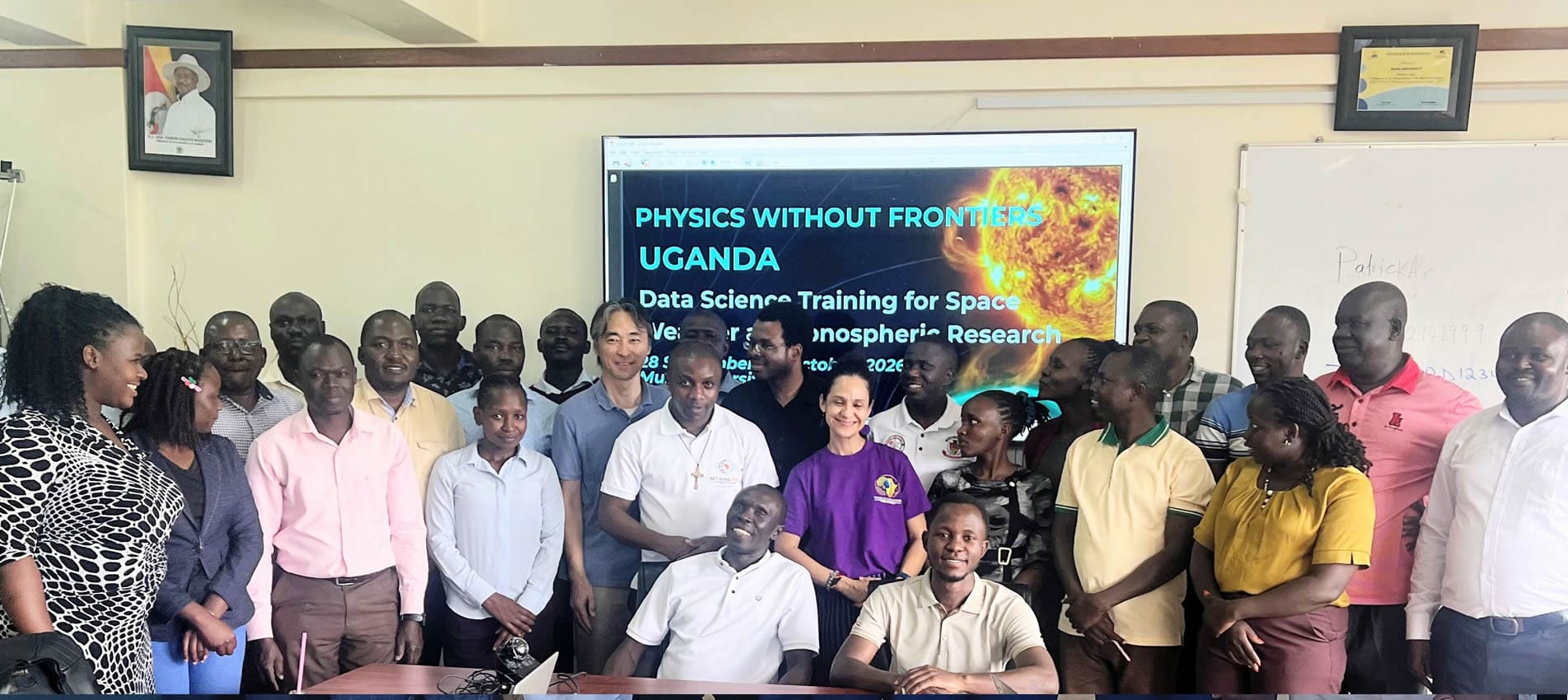
What Happens in Space Does Not Always Stay in Space: Inside the five-day Muni University workshop on Data Science Training for Space Weather and Ionospheric Research, organised by the Department of Physics under the Faculty of Science, 28 September–2 October 2026 at the University Main Campus in Arua City.
At the official opening, Muni University Vice Chancellor Assoc. Prof. Simon Anguma Katrini connected the training to the University’s wider commitment to research, innovation and the development of scientific capacity.
Muni University, through the University’s Department of Physics, is hosting a five-day training on Data Science for Space Weather and Ionospheric Research, bringing together astrophysicists, ionospheric scientists and researchers, space scientists, postgraduate Master of Science students, experts and technocrats from Uganda, across Africa, Japan and Italy.
Assoc. Prof. Patrick Mungufeni, Head of the Department of Physics at Muni University, said the training is helping researchers and students understand how changes high above the Earth can affect technologies people use in everyday life.
“Space weather may sound like something far away from our daily lives, but it can have implications for technologies we use every day. Think about the GPS in your car helping you find your way, or the satellite signals that bring programmes to your television through services such as DStv. Understanding what happens in the space environment helps us understand how such systems can be affected and how we can better prepare for those changes.”
The focus of the week-long training at Muni University is to look upwards, not simply to admire the sky, but to understand the invisible forces constantly moving through space and the upper atmosphere.
When space weather reaches Earth
Space weather may sound like a subject confined to observatories and research laboratories. Its consequences, however, can reach technologies used every day.
Satellites, navigation systems and communication technologies depend on signals travelling through space and the upper atmosphere. Changes in the ionosphere can alter how those signals propagate.
That is why scientists are increasingly interested in measuring and modelling changes in the ionosphere.
One of their most valuable tools is GNSS.
Systems such as GPS continuously transmit signals between satellites and receivers on Earth. By examining how those signals are affected as they travel through the ionosphere, researchers can
estimate Total Electron Content, or TEC, and use the information to study changes in the upper atmosphere.
The same GNSS observations can also contribute to research into Earth's rotation, crustal deformation and other geophysical processes.
For researchers at the workshop, the objective is therefore not simply to learn how to handle data.
It is to learn how to turn enormous quantities of observations into scientific knowledge.
From raw data to space-weather intelligence
The workshop introduces participants to the fundamental principles of scientific data science, including data collection, quality control, processing, analysis and visualisation.
The training then moves from theory to practical research.
Participants learn about satellite orbits, GNSS signals and observables and satellite-data processing before progressing to the extraction of ionospheric TEC from GNSS observations contained in Receiver Independent Exchange (RINEX) files.
They also examine indicators used by scientists to understand space-weather conditions, including the Dst, Kp and Ap indices, as well as solar-wind parameters obtained from satellites such as the Advanced Composition Explorer (ACE).
On the fourth day, students work in groups with GNSS data collected under different space-weather conditions.
On the final morning, they present their findings and discuss what the results reveal.
The structure is deliberately practical.
Students are not simply listening to scientists explain space weather. They are being trained to work with the data themselves.
A programme built over years
The Muni workshop is also the latest chapter in a collaboration that has been developing for several years.
In 2023, Muni University hosted a space-weather and upper-atmosphere data-analysis workshop with support from the Scientific Committee on Solar-Terrestrial Physics (SCOSTEP).
A follow-up programme was held at Mbarara University of Science and Technology in September 2025, with additional support from Physics Without Frontiers (PWF).
Evaluations from the 2025 training identified the need for greater emphasis on the use of GNSS in space-weather and ionospheric research.
The 2026 programme responds directly to that recommendation.
It is also designed around a continuing challenge facing universities in East Africa: students are entering MSc and PhD programmes in physics, but specialised training in space weather, GNSS and ionospheric research is not yet adequately represented in many curricula.
At the same time, governments across the region are establishing space-related institutions and seeking ways to make greater use of their national space environments.
The result is a growing need for researchers who understand both the science and the data.
Muni's astrophysics legacy meets the next generation
The workshop was officially opened by Muni University Vice Chancellor Assoc. Prof. Simon Anguma Katrini, who connected the gathering to the university's wider mission of research, innovation and community transformation.
He described Muni as one of Uganda's fastest-growing universities and encouraged the participants to see the workshop as an important opportunity for their scientific development.
But Assoc. Prof. Anguma's remarks also drew on his own history in astrophysics.
He recalled a period when astronomy was taught under Geography at Makerere University and described his decision to pursue further studies in astrophysics in South Africa.
After returning to Uganda, he said, he advocated for astrophysics to be introduced as a standalone course unit.
“I found astronomy being taught under Geography. When I went to South Africa for further studies in astrophysics, I came back and recommended that astrophysics should be taught as a standalone course unit.”
He also recalled encouraging colleagues, including Prof. Edward Jurua, now at Mbarara University of Science and Technology, to pursue further studies in astrophysics.
For Assoc. Prof. Anguma, the progress of astrophysics in Uganda is partly a story of mentorship: scientists who received opportunities to study, returned home and helped open doors for another generation.
“All these things strengthen astrophysics. Many students have been mentored and nurtured in astrophysics, and today many are enjoying the course.”
He urged the participants to make full use of the opportunity.
Bringing the world to Arua
The international character of the workshop is central to its purpose.
Among the researchers taking part is Yenca Migoya Orue, a researcher at the International Centre for Theoretical Physics (ICTP) in Italy.
She described the programme as part of a long-running collaboration with Muni University and Assoc. Prof. Patrick Mungufeni.
“I have been collaborating with Muni University for more than 10 years. We have published papers together, and this is part of that continued collaboration.”
Migoya Orue said the programme is connected to Physics Without Frontiers, which provides training and opportunities for students from developing countries in different areas of physics.
The Muni workshop, she said, is helping extend that opportunity to Master's and PhD students interested in space science.
“This kind of activity is key and crucial to advancing space-weather studies in Uganda. I am happy to see professors coming together, and I am optimistic about the future.”
A classroom without borders
Prof. Edward Jurua of Mbarara University of Science and Technology said such programmes give students an opportunity to learn directly from specialists from Africa and beyond.
The training combines expert lectures with hands-on practical work, creating an environment in which students can connect scientific theory with real data.
For Muni University, he said, space physics is already an important area of research, making the workshop particularly relevant to the university's research ambitions.
The programme also brings together researchers from several Ugandan institutions, including Muni University, Mbarara University of Science and Technology, Busitema University and Mountains of the Moon University.
Muni's participating researchers include Assoc. Prof. Patrick Mungufeni, Dr. Bosco Henry Oryema and Dr. Cosma Agaba.
The Local Organising Committee includes Dr. Sharon Aol and Dr. Valence Habyarimana of Mbarara University of Science and Technology, Dr. Geoffrey Andima of Busitema University and Dr. Phillip Opio of Mountains of the Moon University.
Japan to Uganda: an international scientific conversation
Among the international experts is Prof. Yuichi Otsuka of Nagoya University's Institute for Space-Earth Environmental Research in Japan.
Otsuka said he was impressed by the students' engagement throughout the workshop.
“All the participants were very attentive and curious about the discussions.”
He said the subject matter could help guide future researchers and expressed appreciation for the hospitality extended by Muni University.
He also thanked Assoc. Prof. Patrick Mungufeni, Head of the Department of Physics at Muni University for spearheading the workshop.
His presence in Arua illustrates the international network being built around space-weather research in East Africa.
The students may be studying in Uganda, but the questions they are learning to investigate are global.
Building the scientific workforce Africa will need
The organisers see the training as an investment beyond the five days in Arua.
Participants who develop advanced expertise in GNSS, space weather and ionospheric research could go on to doctoral studies, university research and teaching, or careers within emerging government space agencies.
The longer-term ambition is to create a sustainable pool of African researchers who can teach the next generation, conduct locally relevant research and participate in international space-science programmes.
For universities, that means building academic capacity.
For governments, it could mean a stronger scientific workforce as national space programmes develop.
For students, it opens a path from a Master's classroom to the wider international space-science community.
From Arua to the wider world
The significance of the Muni workshop ultimately lies in a simple idea: space science is no longer only about looking into space. It is also about understanding how the space environment interacts with the technologies on which modern societies depend.
Africa is increasingly investing in digital infrastructure, satellite applications and space-related institutions. But technology alone is not enough.
The continent also needs scientists who can understand the environment in which those technologies operate.
At Muni University this week, that capacity-building effort is taking place one dataset, one experiment and one emerging researcher at a time.
From the Council Hall in Arua, the scientific conversation is reaching far beyond Uganda — toward a future in which African researchers are not simply consumers of space technology, but active contributors to the science t