
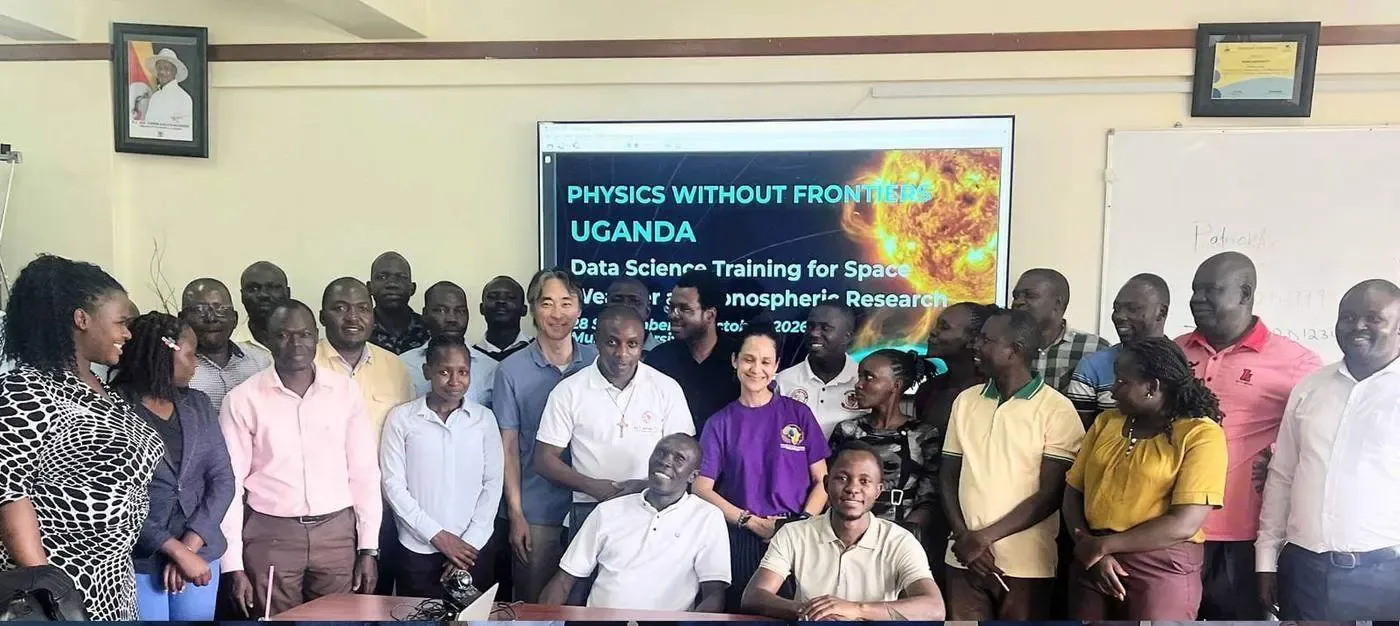
The Department of Physics hosted astrophysicists, ionospheric scientists, MSc students and experts from Uganda, across Africa, Japan and Italy, from 28 September to 2 October 2026.
Space weather may sound far from daily life, but changes high above the Earth can affect the satellites, navigation and communication systems people rely on every day. That was the starting point of a five-day training on Data Science for Space Weather and Ionospheric Research, organised by the Department of Physics in the Faculty of Science at the University Main Campus in Arua City.
Think about the GPS in your car helping you find your way, or the satellite signals that bring programmes to your television. Understanding what happens in the space environment helps us understand how such systems can be affected and how we can better prepare for those changes.
From raw data to space-weather knowledge
Participants worked through the principles of scientific data science — collection, quality control, processing, analysis and visualisation — then moved to practical research: satellite orbits, GNSS signals and observables, and extracting the ionosphere’s Total Electron Content (TEC) from GNSS observations in RINEX files. They examined the Dst, Kp and Ap indices and solar-wind data from satellites such as the Advanced Composition Explorer. On the fourth day students worked in groups on GNSS data from different space-weather conditions, and presented their findings on the last morning.
A programme built over years
Muni hosted a first space-weather data-analysis workshop in 2023 with support from the Scientific Committee on Solar-Terrestrial Physics (SCOSTEP); a follow-up was held at Mbarara University of Science and Technology in 2025 with Physics Without Frontiers. The 2026 workshop answered that training’s recommendation for more emphasis on GNSS — skills still missing from many physics curricula in East Africa as governments in the region set up space agencies.
Opening the workshop, Vice Chancellor Assoc. Prof. Simon Anguma Katrini — himself an atmospheric physicist — described Muni as one of Uganda’s fastest-growing universities and encouraged participants to make the most of the opportunity.